Friday, August 11, 2017

Funds Management in Australia


Fund Management in Australia


The funds management industry in Australia seems to be going from strength to strength with a plethora of new funds coming to market aided by the tailwinds from compulsory superannuation.


The role of active equity managers in Australia does not seem to be diminishing compared to overseas markets such as the US where there has been significant outflows from active managers into passive.


The other noticeable theme in Australia has been the increasing popularity of global funds as domestic equity managers have  struggled for differentiation in an increasingly competitive market that will increasingly become disrupted by enhanced passive investments.


One byproduct of this has been that active managers in Australia have had to lower their fees in some instances.  An example of this has been K2 Asset Management and Platinum Asset Management which have both lowered their management and performance fees across their retail funds in response to declining funds under management.


K2

Platinum


The other feature of funds management in Australia of recent times has been the popularity of permanent capital investment vehicles which target the self managed superannuation market in Australia.


Historically these structures have been listed investment companies (LIC) and the investors in the fund have borne the cost of establishing the fund which can be as high as 3%. Therefore investors start day one already having lost money.


Newer structures such as VGI Partners Global investments Limited LIC and Magellan's Listed Investment Trust (LIT), which is raising up to 9 billion dollers, are having the fees paid by the manager and not buy that investors in the front which is a preferable outcome for investors.


VGI’s LIC


  1. The Manager will not receive any Management Fees until all of the Company’s establishment costs, including the costs of the Offer, have been recouped. As a result the Company is expected to list on the ASX with a net asset value equal to the Offer’s $2.00 issue price (see Section 7 for further details).
  2. The Manager will pay the vast majority of the Company’s ongoing operating costs, including ASX and ASIC fees, audit costs, legal and tax advice costs and any fees charged by the Company’s fund administrator. The Company remains liable for some operational costs and expenses. For example, for corporate governance reasons, the Company remains liable for, and must pay, the costs and expenses of the Directors (including director fees and insurance costs)1 .
  3. The owners of the Manager will commit to reinvesting (on an after tax basis) any performance fees the Manager earns from the Company into Shares, and enter into long-term voluntary escrow arrangements in respect of those Shares


Magellan's offer includes  a "valuable loyalty reward" worth 6.25 per cent to existing investors in their funds up to a total investment amount of $30k.


The outcome from these scenarios if we look at a fund manager's economics as a technology company we are seeing falling ARPU, higher customer acquisition cost but lower churn. The Interesting question is whether the lifetime value (LTV/CAC) ratio is improving?


The fact fund managers are seeking to raise money and permanent capital structures is also indicative of where we are in the market cycle and suggests that the managers believe we are in an environment where capital is easy to raise and they are willing to pay a premium on customer acquisition cost to benefit from not having the risk of redemptions i.e. a higher LTV. Those managers that have secured permanent capital will be able to invest much more aggressively in a downturn and should benefit from improved returns from not having to take a more conservative approach by needing to hold higher levels of cash to meet redemptions which tend to peak as markets are capitulating.


Saturday, July 1, 2017

How do tax rates impact the long-term compounding nature of equities


How do tax rates impact the long-term compounding nature of equities 2 July 2017

There has been a significant amount of analysis on what makes a business a good compounder of capital however one of the most important factors is the tax rate the company must pay.

Companies that pay a low amount of tax will compound capital much faster than companies that pay a higher portion of the earnings in tax. There are ways in which companies in high tax jurisdictions can minimise their level of tax paid by structuring their tax tax affairs however this will often come with associated negative consequences. For example US corporations being unable to repatriate their offshore profits back to the United States as this will trigger a tax liability in the US.

It is easier for some types of companies to structure their taxi affairs than others. Companies that have a high amount of intellectual property or intangible assets can more easily shift those assets offshore to low tax jurisdictions compared to companies that have a high amount of tangible assets which are more difficult to shift

The WalletHub broke down the overall tax rate for the S&P 100 in 2015 using the companies' annual reports. As opposed to the supposed 35% federal statutory corporate tax rate in the US, these companies paid an average rate around 28% for the year, including federal, state, and international taxes.


There come quite often be a difference between the tax expense reported in the financial statements and the actual corporate tax paid due to deferred taxation such as using accelerated depreciation rates for tax purposes.

In the case of Berkshire Hathaway (BH), much of the difference comes from faster depreciation for tax purposes.

WalletHub has BH with a rate of 30.1%. Going to the BH 2015 K-1 (page 68) we find "Earnings before income tax" of $34.946 billion and "Income tax expense" of $10.532 billion, which is 30.1%.  The amount paid which you will find on page 87 was $4.535, which is just 13.0% of pretax income.

In the case of BH, much of the difference comes from faster depreciation for tax purposes. Berkshire's net deferred tax liability grew by $1.263 billion.  And as long as the company continues to put more property in service, at least on a dollar basis, than it retires that deferred tax liability, currently $63.199 billion will likely continue to grow.


Many European countries have taken their approach to have low corporate income tax rates but high value added tax or consumption taxes.


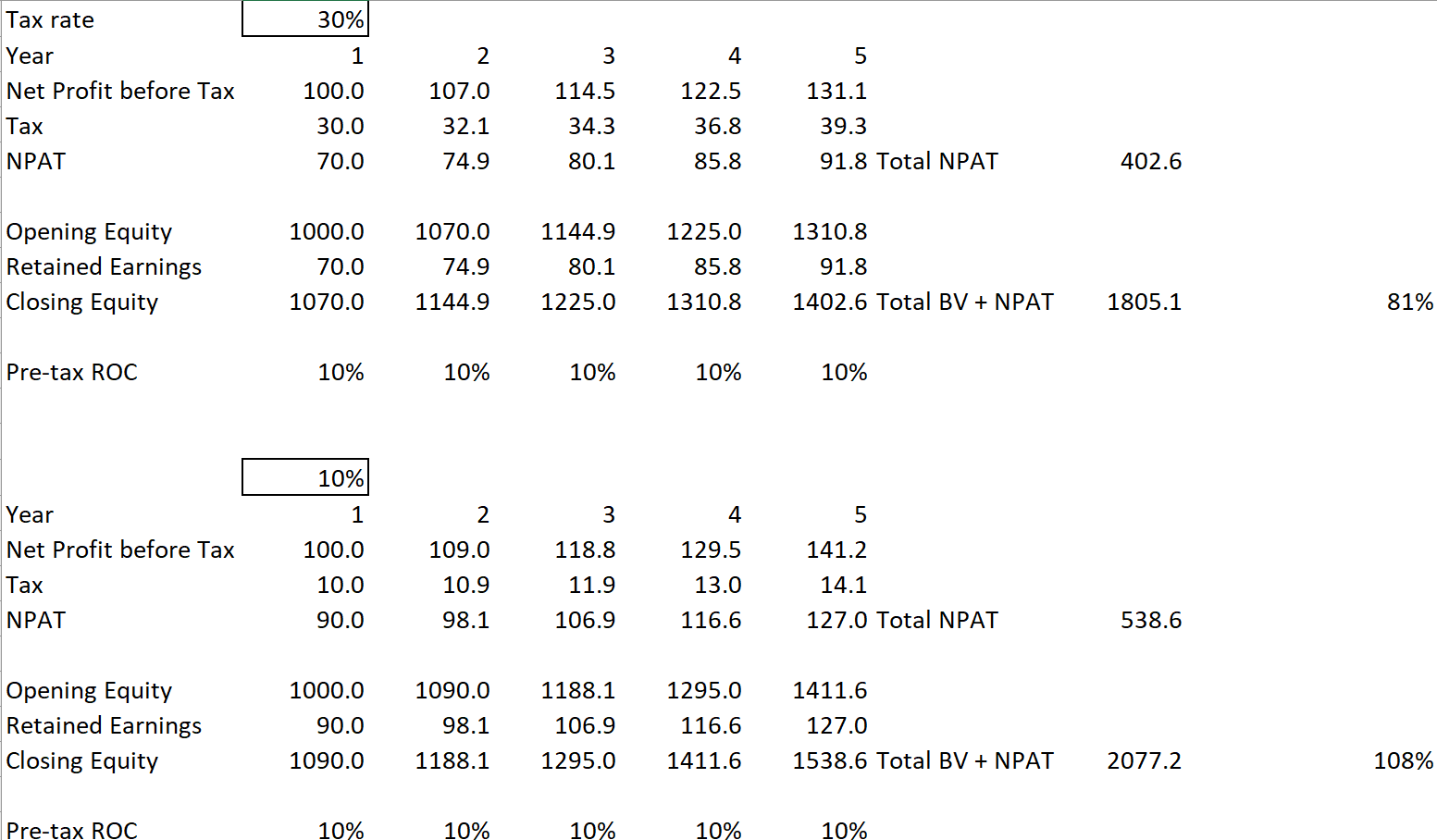
An example of the compounding nature of lower taxes can be seen in the example below.


This would be the equivalent of a company that is based in Australia and paying 30% corporate taxes versus a company based in Bulgaria and paying 10% corporate tax rate. The total return assuming that company was purchased at a book value of 1 times and is still trading it 1 times book value after 5 years is 81% for the company in Australia compared to 108% for the company in Bulgaria.

Conclusions

Investors should pay more attention to the after tax returns companies are generating and also the after tax returns attributable to themselves. Taxes at a personal level should also aim to be minimised by investing through tax efficient structures and residing where possible in lower tax jurisdictions.


Saturday, April 22, 2017

Auckland property crisis

Auckland property crisis


Auckland has gone from the world's fifth least affordable city to its fourth, now trailing only Hong Kong, Sydney and Vancouver as the least accessible housing market.
The 13th annual Demographia International Housing Affordability Survey examined prices to incomes in 406 metropolitan housing markets and put Auckland near the top due to extremely expensive prices but moderate wages.
Auckland's median house price is $830,000 yet residents' median household income is $83,000 giving a multiple of 10, up on last year's 9.7 when house prices were only $748,700 and incomes were $77,500, Demographia says.
Wages have not risen much yet our house prices have spiralled, up 24 per cent in 2015 alone, according to the QV House Price Index.
"Auckland, New Zealand's only major housing market, has a severely unaffordable 10 median multiple," Demographia said.
Since 2004, when the first survey was conducted, Auckland's unaffordability measure had nearly doubled, from a multiple of 5.9 to 10, it said.
1. Hong Kong $5,422,000 $300,000 18.1
2. Sydney $1,077,000 $88,000 12.2
3. Vancouver $830,100 $70,500 11.8
4. Auckland $830,800 $83,000 10
The median multiple is not a perfect measure because it does not account for house sizes or build quality. housing markets. For example what you get as an average house in Auckland is likely to be much larger than in somewhere like in London or New York.
But it is the only index that allows a quick comparison of different


So why have Auckland property prices increased so much? I consider a number of reasons below and conclude with how I would play the Auckland property market.


Under supply


The population in the city has gone up by 45,000 a year. We need about 15,000 extra houses a year and are only building about half that number.
Auckland Council has addressed the problem of not having enough land to build on with the Unitary Plan which, once the appeals process is dealt with, will enable the construction of 422,000 housing units on brownfields developments and 150,000 units on greenfields sites. That should provide an ample supply of land which is the highest cost factor in Auckland housing.


While I agree with the analysis there is undersupply of land being consented for properties I don't necessarily agree that under supply is the core reason for property prices increasing.


Undersupply of housing should also increase rental yields as excess demand pushes up prices. As renting and buying a house to live in a substitutes for accommodation both should had significant prices increases however rental price increases have lagged propertry increases quite substantially as rental increases seem to be tied more to increases in peoples incomes.


I have estimated that the median house price in Auckland has increased by ~12.3% p.a. for the last 5 years but rental income has increased by ~4.7% p.a.


The under supply issue is being addressed through the new unitary plan which will allow subdivision of properties that were previously too small to be subdivided. Furthermore it will allow higher density and more terraced and apartments to be built in areas that previously had density and height restrictions.


The other factor that could increase supply is the move of baby boomers out of their existing houses and into retirement villages and aged care facilities. There is an upcoming shortage of aged care beds especially and to a lesser extent retirement villages, however this should open up more inventory of houses that will be available as these residents transition away from their family homes to aged care accommodation.


Lower interest rates


The low interest rates that have been depressed since the aftermath of the GFC have enabled borrowers to borrow a larger amount than they otherwise would be able to service if interest rates were at the levels prior to the financial crisis.


Low interest rates have increased the attractiveness of borrowing and subsequently resulted in large amounts of credit growth which has further increased the price of property and also other financial assets.


If interest rates do moderate this will cause stress for some borrowers as their incomes are unlikely to increase at the same rate as their interest payments on their mortgage increase.


This may lead to a forced sales of property which could have a domino effect on reducing the value of property stock across the market, increasing the loan to value ratios and putting many borrowers in breach of their loan covenants.


Safe Haven demand


There is an argument that property  is being used by offshore buyers as a store of value and opportunity to remit funds from their home country into New Zealand and other countries because of the instability and potential currency devaluation and their own country.


It is difficult to predict this demand and also hard to control as many of these buyer's are cash buyers and are not influenced by local interest rates or LVR restrictions.


One way to tackle this problem is by introducing restrictions on foreign ownership of properties or increasing the tax burden for offshore buyers in purchasing properties in New Zealand through additional taxes such as a stamp duty.


Tax considerations


In New Zealand the treatment of housing is quite favorable in that losses are able to be deducted against your personal income tax and capital gains are not taxed. Transaction costs are also relatively low compared to other countries. Although this treatment is not dissimilar to other asset classes, property is unique in that it is relatively more stable and therefore can afford a higher amount of leverage against it of which the interest is tax deductible. Therefore investors may not be as concerned about making losses due to high interest deductions  as they received a tax benefit in doing so.


Unitary plan


This factor has not been publicised as much as the above considerations, however I think it is very relevant that for many properties in Auckland use of the land has become more valuable as they can now be subdivided and a higher density accommodation built.


It is difficult to quantify the extent of this increase and the increase in value through subdivision will potentially be offset with valuation falls through higher supply in the market over time. However, it is clear that properties that have benefited from zoning changes have become more valuable. For example, two dwellings could be built on one original section and the level of income produced from the same original size section has now increased to what was achievable previously.


If there had been rezoning the values of the same properties are unlikely to have increased as much.


Valuation


When viewing property I tend to consider it similar to other asset classes and for capital gains to be achievable earnings have to increase. Generally over the long-term assets valuation will depend on level of its output or the level of income the asset produces.  As rental income has fallen far behind price rises over the last 5 or more years either rents will need to start increasing faster than house prices (this will have to be be linked to income increases) or interest rates will have to fall further to justify prices continuing to increase above the rate of rental increases.


I think the former scenario is more likely than the latter scenario especially if there is a true shortage of accommodation properties in Auckland.


The difference with real estate  compared to other assets  is land is finite and as populations grow this will become more and more scarce. Therefore potentially land is viewed as more of a store of value like gold than an income producing asset.


Preferred investments


My preferred property investment would be large land holdings where I can also take advantage of good yields from renting many dwellings or warehouses on the site and benefit from the appreciation in the value of the land as it becomes more scarce.


The two ways I would look at achieving this is by owning large areas of land just outside the city limits or residential properties within 15km of the CBD that have large amounts of land and could potentially be subdivided and the third way would be to own industrial warehouses that sit on large amounts of land and will likely benefit from increasing Urban sprawl and also the increasing use of logistics as a means for distributing products purchased online .

Saturday, April 15, 2017

Book review: Black Edge: Inside Information, Dirty Money, and the Quest to Bring Down the Most Wanted Man on Wall Street By Sheelah Kolhatkar

Book review: Black Edge: Inside Information, Dirty Money, and the Quest to Bring Down the Most Wanted Man on Wall Street By Sheelah Kolhatkar
Finished reading: 09 April 2017


This book focuses on operations of SAC Capital which is also currently being roughly portrayed in the current TV series Billions.
The book is the most in depth account of the various indictments and convictions that occurred from the operations at SAC Capital. The book goes into more detail around particular trades that were investigated by the ACC and FBI.  What I found particularly interesting was the insight into how SAC operated in order to prevent Steven Cohen from directly receiving insider information. The book also highlighted the ruthless nature of Steven Cohen towards his portfolio managers and how he would use them as a source of illegal tips from their networks but as soon as any trouble was caused or bad tips were received he word dispose of them immediately.


I found it disappointing that many of the convictions that were achieved have now been overturned on appeal and the definition of Insider trading has now been made more difficult to prove as it requires that the government must prove that the tippee knew “that the tipper disclosed the information for a personal benefit and that the tipper expected trading to ensue.


Overall I found it fascinating how SAC was able to operate for so long blatantly trading on inside information and how everyone turned a blind eye to it especially other firms in the market such as brokers who were directly benefiting from the high level of commissions paid to them from SAC capital.
Insider trading acts as a tax on the market whereby although there are no specific identified victims the profits flow to those who have the benefit of the information and it acts as a tax or cost to those who do not have information as they are on the opposite side of the trade.


Conclusion
The book was very well written but I didn't take away many new insights from the book apart from understanding more around SAC Capital operations and how it is far more difficult to prosecute Insider trading going forward.


Book review: RICH KIDS: How the Murdochs and Packers lost $950m in One.Tel By Paul Barry

Book review:

RICH KIDS: How the Murdochs and Packers lost $950m in One.Tel By Paul Barry

Finished reading: 13 April 2017


This book was given to me by guests staying at our house it was particularly interesting reading given the ambitions of One.Tel are very similar to what TPG Telecom is trying to do in the Australian mobile market currently by becoming the fourth player and building their own network and buying spectrum.
The book was very well written and scintillating to read. I had heard of Jodee Rich before but not read any detail about the collapse of One.Tel. It is very interesting to identify the common themes that were present in both of Jodie Rich's listed company collapses; Imagineering and One.Tel.


The key points I got from the book were that people do not often change and the misrepresentation and deceiving tactics that Jodee Rich used at Imagineering were almost exactly replicated at One.tel a decade later It also shows how smart people can be deceived and if you become too close to a situation you fail to make rationale observations that would be obvious to an outsider.


The One.Tel collapse also highlighted the speculative nature of what was happening in the market during the dotcom boom and the terrific paper wealth that investors had made, but in reality not much real wealth was being created.


What surprised me was that Jodee Rich was not punished for his role in the company and how he still has a business life in Australia today despite losing investors billions of dollars and deceiving some of the most sophisticated investors in Australia.

Conclusion


I enjoyed the book thoroughly and would recommend it to anyone who is wanting a background on the Telco industry in Australia and management deception.  It highlights the risks around businesses that are in hyper growth mode and shows how they can unravel just as fast.

Sunday, January 29, 2017

Book review:

The Emotionally Intelligent Investor: How self-awareness, empathy and intuition drive performance by Ravee Mehta

Finished reading: 29 Jan 2017


I found the book to be incredibly valuable as it includes valuable insights into how to become a better investor. Historically most of the literature I have read on investing has been focused on value investing. More recently I have begun to read more literature on traders. This book provides comfort to the investor that there is no one correct approach and they should choose their own style that fits towards their personality and not try to shape themselves within a particular style of investing. “Relying on someone else’s work simply does not put you in control.  There is nothing wrong with listening or reading about the ideas of others, but in the end, you need to do your own analysis and make decisions that fit an investing style based on your own personal set of strengths, weakness, motivations and personality characteristics”. “Value investing involves trying to make money by guessing that the pendulum is near the end of its swing, all the way to the left or all the way to the right, and that it should eventually swing the other way.  Growth or Momentum investing involves betting that the pendulum will continue in its current direction, left to right (let’s call it “bullish”) or right to left (let’s call it “bearish").  Success in each of these styles generally requires distinct personality traits and strengths.”

It is also important to understand the underlying motivation for yourself as an investor as this work infor your basic philosophy on investing. “The author’s conclusion is the best long-lasting motivator for success is self-improvement based.  Instead of focusing on how much money I make or whether I am wrong or right on a given investment, I try to put the focus on continuous learning.”

The first part of the book the author describes of various cognitive biases and suggest when we may become susceptible to these biases and the likely effects from falling prey to them.
The author spends a lot of time describing how he tries to emphasize with other investors in the market and in the particular stocks he is looking to invest. An understanding of how other investors are feelign will inform him as to how the stocks will likely behave given the investors reactions.
For example he tries to understand whether the existing investors are mainly growth type or value type investors as they will behave differently to stock price movements and earnings announcements.

Another interesting observation is why intuition should not be ignored especially when intuition has been built up through years of observations in a particular field. Intuition is valuable because of the patterns that investors are able to draw two similar past investments and the likelihood of certain outcomes occurring from a particular set of facts.

The author advocates keeping a trading journal and being very introspective as and analysing past decisions and why they were made . One useful exercise is to keep a journal in which you try to keep track of when and how often you fall victim to these common mistakes as well as when you are successful in avoiding them. It can be useful to write down in a journal what type of mood you are in.  “The better we can understand our feelings, the better we will be able to control and recognize how they impact our decision-making.” “Kasparov believes that the secret to success in chess and in most other endeavors is a relentless review of prior decisions and focused practice on areas that require improvement.  Critiquing prior decisions develops intuition, because it increases the odds that prior patterns stick somewhere in one’s mind.”

The author describes that our common investing mistakes can be placed into three categories:  Self-defense mechanisms against feeling shame, regret and fear.  Irrational reactions to stress and overloading of the brain’s capacity for rational thought.  Vulnerabilities caused by fluctuations in mood.

Another tip that came out of the book was to visualise how an investment could perform before investing, especially on the down side. By visualising this scenario it will better prepare you for how you will react in such a situation. It is also beneficial to seek out the counsel of other investors as they are more likely to see the pitfalls in an investment rather than yourself, given the cognitive biases you have to an investment idea that you have generated personally.

The author also advocates the use of technical analysis to understand what the market is feeling towards a stock. He combines the use of intuition based on pattern recognition, fundamental analysis which is based more on deliberate rational thought and technical analysis to emphasise with how the market is feeling about a stock.

Conclusion

This is one of the best books I have read in a long time as it contains reflections from an investment practitioner who has spent a lot of time in self reflection and endeavoured to understand what techniques are helpful for improving process and becoming a better investor and human being.

Monday, January 9, 2017


Finished reading: 9 Jan 2017


The book provides a good summary of the key principles that came from the Buffett Partnership letters.


How to think about the market
As has been written many times before the letters emphasises Buffett approach to investing in businesses and not stocks. There is a common theme that stocks should be held for the long term and that the long-term performance from stocks will be determined by the underlying fundamentals that the business generates.


The fact that businesses have a quotation should be used to the investors’ advantage and at all other times they should be free to disregard the current price quotation. Buffett believes the investor would be better off if there was no stock market quotation at all for he would then be spared the mental anguish caused to him by other persons mistakes of judgement.


Think of stocks (1) as fractional claims on entire businesses, (2) that swing somewhat erratically in the short term but (3) behave more in line with their gains in intrinsic business value over the longer term, which, when (4) viewed through the lens of a long-term compounding program (5) tend to produce pretty good results, which, with (6) an index product, can be captured efficiently in a low-cost, easy-to-implement way. From here we’re going to turn to Buffett as an active investor, starting with his ideas on what exactly he’s setting out to achieve and how he intends to measure it.


Redemptions / withdrawals
Interesting insights that I learnt was that Buffett operated a system whereby partners could only withdrawal once per year and if they wanted to withdraw before that time they could do so however at a cost of 6% interest. Partners could also pre-fund year end additions where the partners would receive 6% therefore compensating those who wish to add to the existing investment.


Buffett’s investments were divided into three categories being generals, workouts and controls.


Generals
Many of the generals were acquired at steep discounts to their appraised intrinsic value. These companies tended to be much smaller companies where if the stock remain dormant and price for long enough Buffett would come to gain a large in stake to have a say over how it was being run.


Buying Generals represented a two strings to a situation where Buffett would either benefit from an appreciation in the securities price as a minority shareholder or force events to occur by gaining control of the company and acting as a corporate Raider.


Buffett believed his return from investing in Generals over the 12 year history of the Buffett partnerships was probably 50 times or more is total losses.


Buffett also implemented a long-short strategy. Buffett mitigated some of that risk by hedging them, meaning when he bought one he would sell short1 the more expensive peer company. For example, by buying a stock trading at 10 times earnings and simultaneously shorting a similar company trading at 20 times earnings, Buffett reduced the risk of overpaying for the company he liked because if it declined to, say, 8 times, one would expect the stock of the company he sold short (at 20 times) to decline further.


Quality compounder method
However, as they years passed and opportunities to put money to work in the small capitalisation Generals diminished Buffett became more focused on the qualitative aspects of business. Instead of jumping from undervalued stock to another undervalued stock Buffett realised that this was the wrong foundation on which to build a large and enduring enterprise.
“So the really big money tends to be made by investors who are right on qualitative decisions but, at least in my opinion, the more sure money tends to be made on the obvious quantitative decisions.”
Here is a checklist for evaluating a potential investment in a General: (1) Orient: What tools or special knowledge is required to understand the situation? Do I have them? (2) Analyze: What are the economics inherent to the business and the industry? How do they relate to my long-term expectations for earnings and cash flows? (3) Invert: What are the likely ways I’ll be wrong? If I’m wrong, how much can I lose? (4) What is the current intrinsic value of the business? How fast is it growing or shrinking? And finally, (5) Compare: does the discount to intrinsic value, properly weighted for both the downside risk and upside reward, compare favorably to all the other options available to me?
Buffett also emphasised being very selective about your investments.
I will only swing at pitches that I really like. If you do it 10 times in your life, you’ll be rich. You should approach investing like you have a punch card with 20 punch-outs, one for each trade in your life.
Work-outs
Everyone can benefit from the diversification workouts offer, but workouts aren’t something everyone is going to be comfortable doing. For the latter group, other outlets exist for investing that can produce high returns and are also not tightly correlated to the overall market direction from day to day.


Buffett often did use leverage when investing in special situations, or “workouts” as he called them.


Controls
“Everything else being equal, I would much rather let others do the work. However, when an active role is necessary to optimize the employment of capital, you can be sure we will not be standing in the wings.”


Some of the best situations arise when you find a General where you can make a significant investment of your own but some other investor is doing the work to improve management’s decision making. Today activists are still agitating managements to improve their operations. In fact, it’s become a very popular strategy that has gained a lot of attention; the funds dedicated to this activity have attracted a lot of assets.


The later partnership letters Buffett was commenting on how he was revising down his goal of outperformance over the Dow as a function of having much more money under management and also the general level of the market. Buffett was also disparaging of momentum and growth funds that performed well when the market was strong but suffered significant impairments when the market turned. Buffett believed such funds where an attempt to anticipate market action over business valuations.


Buffett decided to shut down his partnership in 1969 as he thought an all-out effort to continually beat the Dow was not what he wanted to pursue going forward. He would rather pursue other ideas in the investment field that do not promise the greatest economic reward such as buying a great business and owning the forever.


Feedback
The book was a good summary of the Buffett Partnership letters. I think it would be valuable to go through the letters themselves in chronological order as sometimes I felt that the book jumped around in time periods as it attempted to collate comments from the letters under particular topics. I think you would also gain more from the examples provided by reading the letters themselves.


Conclusion
Overall I would recommend the book. It is easy to read and provide a good summary of how Buffett was so successful investing in the Partnerships.